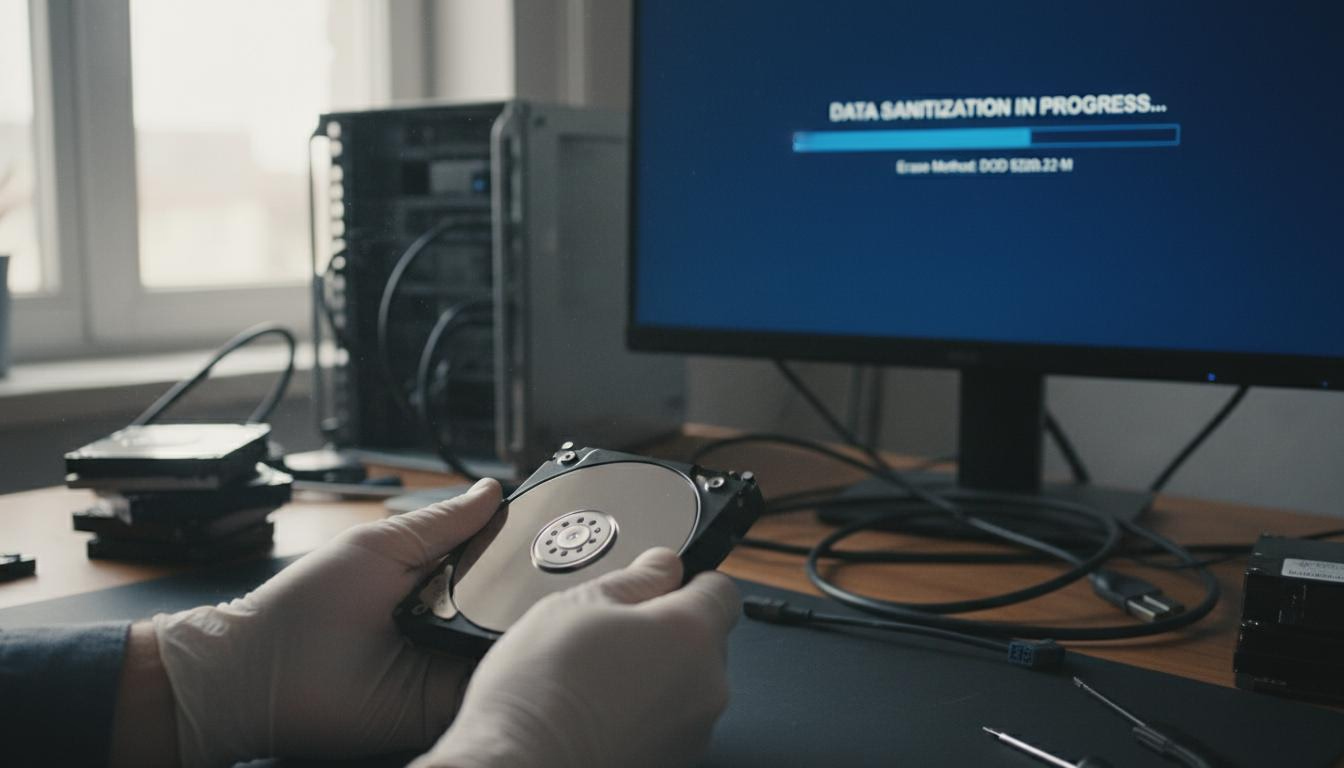
When the US National Institute of Standards and Technology published SP 800-88, "Guidelines for Media Sanitization," they created what has become the global standard for data destruction. In Japan, where data protection requirements under APPI create strict obligations for how organizations handle personal information, NIST 800-88 provides the technical framework that helps companies meet those obligations with confidence.
This guide explains what NIST 800-88 is, how its three sanitization methods work, how to implement it in Japan, how it compares to other standards, and how to integrate it with your APPI compliance program. Whether you're an IT director establishing data destruction policies or a compliance officer validating that your organization's practices meet regulatory requirements, this guide provides the technical depth you need.
What Is NIST 800-88 and Why It Matters in Japan
NIST Special Publication 800-88 Revision 1, released in 2014, provides guidelines for sanitizing data on storage media. While it's a US government publication, it has been adopted globally by organizations that need authoritative guidance on data destruction. In Japan, it's widely recognized as the standard against which data destruction practices are measured.
The standard matters in Japan because APPI requires organizations to take "necessary and appropriate measures" to protect personal data, including preventing leakage when equipment is retired. NIST 800-88 provides a framework for determining what measures are "necessary and appropriate" based on the sensitivity of the data and the risk environment.
When APPI was amended in 2022, the Personal Information Protection Commission issued guidance that referenced international standards for data protection. While NIST 800-88 isn't explicitly mandated, it's widely accepted as demonstrating compliance with APPI's data destruction requirements. Organizations that follow NIST 800-88 can defend their practices as meeting the standard of care expected under Japanese law.
For multinational companies, NIST 800-88 provides consistency. The same standard can be applied across global operations, simplifying policy development and ensuring that Japan operations meet the same standards as other regions. This is particularly valuable for companies that need to satisfy both Japanese regulators and global compliance frameworks.
The Three Methods of NIST 800-88 Data Sanitization
NIST 800-88 defines three categories of sanitization: Clear, Purge, and Destroy. Each is appropriate for different situations based on data sensitivity, media type, and risk environment.
Clear: Logical Techniques for Low-Risk Scenarios
Clear methods use logical techniques to overwrite data with non-sensitive patterns. The goal is to protect against simple non-invasive data recovery techniques—essentially, to prevent someone from simply reading the media and finding your data.
The most common Clear method is single-pass overwrite, where the entire media surface is written with a pattern of zeros, ones, or random data. This overwrites the previous data, making it unrecoverable through standard read operations. For magnetic media, this is effective against software-based recovery tools.
Clear methods are appropriate when:
- The media will remain within organizational control
- Data sensitivity is low to moderate
- The primary threat is casual access, not sophisticated recovery
- Media will be reused within the organization
Clear methods are NOT appropriate for:
- Media that will leave organizational control
- Highly sensitive data (financial records, personal information, trade secrets)
- Solid-state drives (due to wear leveling and overprovisioning)
- Situations where regulatory compliance requires higher assurance
The limitation of Clear methods is that they don't address sophisticated recovery techniques. Advanced forensic laboratories can potentially recover data from media that has been simply overwritten, especially from magnetic media where traces of previous data may remain. For most ITAD scenarios where equipment leaves organizational control, Clear is insufficient.
Purge: Physical and Logical Techniques for High Assurance
Purge methods use techniques that make data recovery infeasible using state-of-the-art laboratory techniques. This is the standard for most business ITAD scenarios where equipment will be resold, recycled, or otherwise leave organizational control.
For magnetic hard disk drives, Purge methods include:
Secure Erase commands: The ATA Secure Erase command built into modern hard drives triggers a firmware-based erase that overwrites all user-accessible areas including reallocated sectors. This is more thorough than software overwriting because it reaches areas that operating system tools can't access.
Block erase: For drives that support it, block erase commands can quickly erase large sections of storage. This is faster than traditional overwriting but provides similar assurance.
Cryptographic erasure: If the drive was encrypted, destroying the encryption keys renders the data inaccessible without actually overwriting it. This is very fast and is appropriate when encryption was properly implemented throughout the data lifecycle.
For solid-state drives (SSDs), Purge methods include:
SSD-specific secure erase: SSDs implement secure erase commands that account for flash storage characteristics like wear leveling and overprovisioning. These commands reach areas of the drive that software overwriting can't access.
Cryptographic erasure: As with magnetic drives, destroying encryption keys is effective for encrypted SSDs. This is often the preferred method for SSDs due to their architecture.
Purge methods are appropriate when:
- Media will leave organizational control
- Data sensitivity is moderate to high
- Regulatory compliance requires documented sanitization
- Media may be resold or reused
Purge methods provide the right balance of security and practicality for most ITAD scenarios. They make data recovery infeasible for all practical purposes while allowing media to be reused or resold, preserving value and reducing environmental impact.
Destroy: Physical Destruction for Maximum Assurance
Destroy methods involve physically damaging the storage media so that data recovery is impossible. This is the highest level of assurance and is appropriate for the most sensitive data or when the highest level of confidence is required.
Physical destruction methods include:
Shredding: Industrial shredders cut storage media into small pieces, making reconstruction and data recovery impossible. Shredding is effective for all media types and provides immediate visual confirmation of destruction.
Crushing: Hydraulic crushers deform hard drives and other storage media, destroying the platters and read/write mechanisms. Crushing is faster than shredding for large volumes and provides clear evidence of destruction.
Degaussing: High-powered magnetic fields destroy data on magnetic media by disrupting the magnetic domains that store information. Degaussing is effective for magnetic tapes and hard drives but doesn't work on SSDs or optical media.
Incineration: Burning storage media destroys both the media and any data it contains. This is typically used for highly sensitive materials and provides complete destruction.
Disintegration: Specialized equipment grinds media into fine particles. This is the most thorough destruction method and is used for the highest-security applications.
Destroy methods are appropriate when:
- Data is classified or highly sensitive
- Media is damaged and can't be purged
- Maximum assurance is required regardless of cost
- Media is obsolete and has no residual value
The trade-off with Destroy methods is that they eliminate any residual value from the media. A hard drive that could have been resold for ¥5,000 becomes scrap metal worth a few yen. For organizations with large volumes of equipment, this cost can be significant.
Implementing NIST 800-88 in Japan: Practical Steps
Implementing NIST 800-88 in your Japanese operations requires a systematic approach that addresses policy, process, and verification.
Step 1: Asset Classification and Risk Assessment
Begin by classifying your data and equipment based on sensitivity. Not all data requires the same level of protection, and not all equipment needs the same sanitization method.
Create data classification categories that align with your organization's risk tolerance and regulatory requirements. A typical three-tier classification might include:
Public/Low sensitivity: Information that could be disclosed without harm. This might include marketing materials, published financial reports, or general business information. Clear methods may be sufficient for this data.
Internal/Moderate sensitivity: Information that should be protected but where unauthorized disclosure would cause limited harm. This includes most business operational data, employee information, and routine customer data. Purge methods are appropriate for this data.
Confidential/High sensitivity: Information where unauthorized disclosure would cause significant harm. This includes financial records, personal information subject to strict regulatory protection, trade secrets, and strategic plans. Destroy methods or enhanced Purge methods are appropriate for this data.
Map your IT equipment to these classifications based on what data it has stored. A laptop used by the CFO likely contains more sensitive data than a laptop used for conference room presentations. This mapping determines what sanitization methods are appropriate for each piece of equipment.
Step 2: Select Appropriate Methods by Device Type
Different storage technologies require different approaches. NIST 800-88 provides specific guidance by media type.
For traditional magnetic hard disk drives (HDDs), Purge methods using ATA Secure Erase are typically appropriate. Secure Erase reaches all user-accessible areas including sectors that have been reallocated due to errors. For highly sensitive data, physical destruction through shredding or crushing provides additional assurance.
For solid-state drives (SSDs), the architecture complicates sanitization. SSDs use wear leveling to distribute writes across the drive, and they maintain overprovisioned areas that aren't visible to the operating system. Simple overwriting may not reach all stored data. For SSDs, cryptographic erasure (if encryption was used) or SSD-specific secure erase commands are the preferred Purge methods. Physical destruction is appropriate for highly sensitive SSD data.
For magnetic tapes, degaussing is the standard Purge method. A properly applied degaussing field destroys all data on the tape. Physical destruction through shredding is appropriate for highly sensitive tapes or when degaussing equipment isn't available.
For optical media (CDs, DVDs), physical destruction is the only reliable method. The dye layer that stores data can be destroyed by shredding or grinding. Simply breaking a disc may not destroy all data.
For mobile devices and tablets, the approach depends on the storage technology. Devices with SSD storage should be treated like SSDs. Many mobile devices support remote wipe commands that can be effective for Purge-level sanitization. Physical destruction is appropriate for highly sensitive devices.
Step 3: In-House vs. Outsourced Sanitization
Decide whether to perform sanitization in-house or outsource to a professional ITAD provider. This decision depends on volume, expertise, and compliance requirements.
In-house sanitization may be appropriate if:
- You have relatively low volumes of equipment to process
- You have staff with the technical expertise to perform sanitization correctly
- You can invest in the necessary tools and equipment
- You have procedures for verification and documentation
Outsourced sanitization is typically preferred if:
- You have significant volumes of equipment
- You need specialized equipment (industrial shredders, degaussers)
- You require certificates of destruction for compliance
- You want to transfer liability to a professional provider
Most organizations in Japan outsource sanitization to professional ITAD providers who have the equipment, expertise, and certifications to perform the work correctly. This also provides third-party verification that can be valuable for compliance and audit purposes.
Step 4: Documentation and Audit Trail Requirements
NIST 800-88 emphasizes the importance of documentation. You need to be able to demonstrate that sanitization was performed correctly and that proper procedures were followed.
For each piece of equipment processed, maintain records that include:
- Asset identifier (asset tag, serial number)
- Equipment type and model
- Data classification
- Sanitization method used
- Date and time of sanitization
- Person or provider who performed sanitization
- Verification method and results
- Final disposition (resale, recycling, destruction)
This documentation creates an audit trail that demonstrates compliance with NIST 800-88 and, by extension, with APPI requirements. The documentation should be retained according to your organization's record retention policy, typically 7 years for most business records.
Step 5: Integration with APPI Compliance Program
NIST 800-88 sanitization should be integrated into your broader APPI compliance program. This ensures that data destruction is addressed systematically rather than as an afterthought.
Include NIST 800-88 procedures in your organization's information security policy. Specify which sanitization methods are required for different data classifications and who is responsible for ensuring sanitization is performed.
Train staff on proper procedures for equipment retirement. This includes how to identify when equipment needs to be sanitized, how to handle equipment pending sanitization, and who to contact for sanitization services.
Include sanitization in your incident response procedures. If equipment is lost or stolen, you should have procedures for remote wiping (for devices that support it) and for documenting what data was on the device.
Regularly audit your sanitization practices to ensure compliance with NIST 800-88 and your internal policies. This might include reviewing documentation, inspecting equipment awaiting sanitization, and verifying that providers are performing as contracted.
NIST 800-88 vs. Other Standards: A Comparison
While NIST 800-88 is widely used, it's not the only data destruction standard. Understanding how it compares to other standards helps you make informed decisions about which framework to adopt.
NIST 800-88 vs. DoD 5220.22-M
The Department of Defense 5220.22-M standard, specifically the "3-pass overwrite" method, was long considered the gold standard for data destruction. It specified overwriting with a specific pattern three times to ensure data was unrecoverable.
However, DoD 5220.22-M is now considered outdated for modern storage technologies. The standard was developed for magnetic media and doesn't address SSDs, flash storage, or other modern technologies. The 3-pass overwrite was designed for older magnetic drives with lower data densities; modern drives with perpendicular recording technology don't require multiple passes for effective sanitization.
NIST 800-88 is more current and comprehensive. It addresses modern storage technologies and provides a risk-based framework for selecting appropriate methods. For most organizations today, NIST 800-88 is the preferred standard.
That said, some organizations, particularly government contractors and those in highly regulated industries, may still be required to follow DoD 5220.22-M for contractual or regulatory reasons. In such cases, NIST 800-88 can be used as a supplement to address technologies not covered by DoD.
NIST 800-88 vs. ISO 27001
ISO 27001 is an information security management standard that includes requirements for data destruction but doesn't specify technical methods. It requires that organizations have procedures for secure disposal of media but leaves the specifics to the organization.
NIST 800-88 provides the technical detail that ISO 27001 lacks. Organizations that are ISO 27001 certified can use NIST 800-88 as the technical implementation of their ISO 27001 data destruction controls. This combination provides both the management framework of ISO 27001 and the technical guidance of NIST 800-88.
For organizations seeking ISO 27001 certification in Japan, demonstrating that your data destruction practices follow NIST 800-88 can help satisfy auditor expectations for technical rigor.
NIST 800-88 vs. GDPR Data Erasure Requirements
The EU's General Data Protection Regulation includes "right to erasure" requirements that mandate deletion of personal data in certain circumstances. While GDPR doesn't specify technical methods, it does require that deletion be effective.
NIST 800-88 provides methods that satisfy GDPR's effectiveness requirement. The Purge and Destroy methods of NIST 800-88 make data recovery infeasible, which should satisfy GDPR's requirement for effective erasure.
For multinational companies that need to comply with both GDPR and APPI, NIST 800-88 provides a common technical framework that can be applied consistently across regions.
Common NIST 800-88 Implementation Mistakes
Even with good guidance, organizations often make mistakes when implementing NIST 800-88. Here are the most common pitfalls to avoid.
Using Clear When Purge Is Required
The most common mistake is using Clear methods (simple overwriting) when Purge methods are required. This typically happens when organizations use basic formatting tools or free wiping software that doesn't meet NIST 800-88 standards.
For equipment that will leave organizational control, Purge methods are almost always required. Clear methods are only appropriate for low-risk scenarios where media remains under organizational control.
Inadequate Verification
Performing sanitization without verifying that it was successful creates compliance risk. Verification should be performed for every piece of equipment processed, not just spot-checked.
Verification methods vary by sanitization approach. For software wiping, verification involves reading the media to confirm overwritten patterns. For cryptographic erasure, verification involves confirming key destruction. For physical destruction, verification involves visual confirmation of damage.
Not Accounting for All Storage Locations
Modern devices have storage in multiple locations that might be missed by simple sanitization approaches. SSDs have overprovisioned areas that aren't visible to the operating system. Mobile devices may have removable storage (SD cards) in addition to internal storage. Computers may have multiple drives or cached data in unexpected locations.
A thorough inventory that identifies all storage media is essential. Sanitization procedures must address all identified storage, not just the obvious locations.
Failing to Update Policies for New Technologies
Storage technology evolves rapidly. Policies written five years ago may not address current technologies like NVMe SSDs, cloud storage, or mobile devices. Regular policy reviews ensure that your NIST 800-88 implementation keeps pace with technology.
Insufficient Training for Personnel
Even the best policies are ineffective if staff don't follow them. Personnel who handle equipment retirement need training on proper procedures, including how to identify storage media, what sanitization methods to use, and how to document the process.
Training should be provided when personnel are hired, when procedures change, and periodically as refreshers. Documentation should be readily accessible so staff can reference it when needed.
---
About AKRIN
AKRIN K.K. is a Tokyo-based managed IT services company founded in 2024, providing NIST 800-88 compliant data destruction services with kobutsusho kyoka licensing. We help international companies in Japan implement proper data sanitization procedures that satisfy both technical requirements and regulatory obligations under APPI. Contact us for a free consultation on your data destruction program.
---
Related Articles
- ITAD Japan: Complete Guide to Secure IT Asset Disposition
- Secure Data Wiping Japan: Methods and Compliance
- Data Destruction Certificate Japan: Compliance Requirements
---