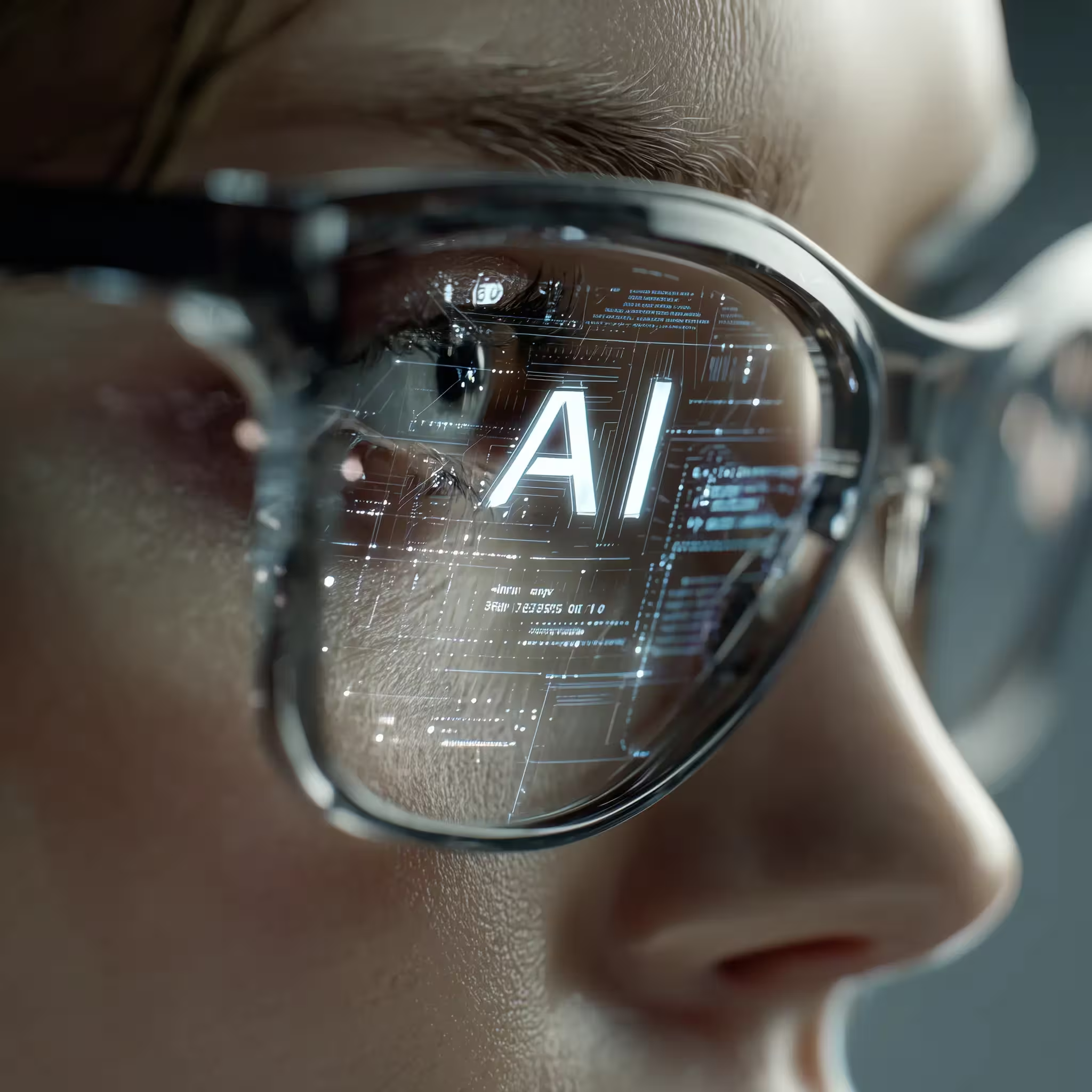
How AI is Transforming IT Support Services in Japan 2025
Japan is positioning itself as an AI powerhouse, with over 20,000 Pepper robots deployed globally and major corporations like JAL implementing company-wide AI platforms for tens of thousands of employees. Artificial intelligence is rapidly transforming information technology services in Japan, automating processes, enhancing cybersecurity, and reshaping IT operations across industries. The transformation of IT support through artificial intelligence is not just a trend—it's a fundamental shift in how we deliver and experience technology services in 2025 and beyond.
AI plays a critical and pivotal role in automating tasks, improving cybersecurity, enabling predictive analysis, and shaping industry trends, positioning artificial intelligence as a core component of IT operations and innovation.
This shift is being driven by the adoption of industry AI, which is enabling sector-wide transformation in IT operations, infrastructure, and service management. As a result, information technology is evolving to become more efficient, secure, and responsive to business needs. AI is also facilitating the integration, management, and security of various IT systems within organizations, connecting different platforms, analyzing data for incident prediction, and enhancing cybersecurity measures.
The integration of AI has moved the IT industry from reactive support to proactive, autonomous management by 2026.
At the core of these advancements, computer science serves as the foundational discipline that enables the development and application of AI technologies for IT support. Robust computer systems provide the essential infrastructure for AI functionalities such as neural networks and machine learning, supporting the processing, training, and deployment of AI models. AI is expected to create smarter, more scalable solutions that can think and make decisions on the fly, faster than ever before.
The AI Revolution in IT Support Services
The global IT Service Management (ITSM) market is experiencing explosive growth, expanding from USD 10.5 billion in 2023 to a projected USD 22.1 billion by 2028, with a CAGR of 15.9%. This growth is largely driven by AI integration, which is transforming every aspect of IT support from intelligent ticket routing to predictive maintenance and automated remediation. Organizations are increasingly adopting AI solutions to enhance IT support, streamline operations, and address evolving business needs. Many of these solutions utilize various machine learning techniques such as deep learning, neural networks, and decision trees to optimize IT support processes.
At AKRIN, we've witnessed firsthand how artificial intelligence is revolutionizing IT support delivery across Japanese enterprises. From multinational corporations to local businesses, organizations are leveraging AI to enhance service quality, reduce response times, and improve user satisfaction. Cloud computing plays a crucial role in enabling scalable AI support platforms, allowing for faster data processing and smarter automation.
Ongoing AI development continues to drive innovation in IT support, shaping the future of information technology service artificial intelligence. Advances in complex machine learning have enabled more adaptive and intelligent IT support systems, allowing for continuous improvement and more effective problem resolution.
History and Evolution of AI
The journey of artificial intelligence (AI) spans more than seven decades, marked by groundbreaking innovations and transformative milestones in computer science. The concept of creating machines that could mimic human intelligence first took shape in the 1950s, when pioneers like Alan Turing and Marvin Minsky began exploring the possibilities of intelligent systems. The term "artificial intelligence" was officially coined in 1956 by John McCarthy at the historic Dartmouth Conference, setting the stage for decades of research and development.
Early AI systems were primarily rule-based, designed to perform specific tasks such as playing chess or solving mathematical problems. These early efforts laid the foundation for expert systems in the 1980s, which used encoded human knowledge to support decision making in specialized domains. However, these systems were limited by their reliance on predefined rules and struggled to adapt to new or unstructured data.
The 1990s ushered in a new era with the rise of machine learning algorithms, enabling computers to learn from data and improve their performance over time without explicit programming. This shift allowed AI models to analyze data, recognize patterns, and make predictions, greatly expanding the range of possible applications. The advent of deep learning in the 21st century, powered by neural networks and increased computing power, further accelerated progress. Deep learning algorithms enabled AI to analyze complex data such as images, speech, and natural language, driving advances in computer vision and natural language processing (NLP).
One of the most significant recent breakthroughs has been the emergence of generative AI, which leverages advanced machine learning models to create original content—ranging from text and images to music and code. Generative AI has become a cornerstone of modern AI-powered tools, including AI-powered chatbots and virtual agents that can interpret human language, provide personalized support, and automate routine tasks in information technology.
As AI technology has evolved, its integration into information technology has become increasingly sophisticated. AI-powered systems now play a critical role in automating routine tasks, enhancing data management, and optimizing system performance. Intelligent systems combine machine learning, deep learning, and natural language processing NLP to analyze complex data and deliver actionable insights, transforming how IT departments operate and support users.
However, the rapid advancement of artificial intelligence AI also brings important challenges. Concerns about job displacement, the use of biased data in training AI algorithms, and the need for robust human oversight have become central to discussions about AI ethics. Ensuring that AI systems are transparent, explainable, and aligned with human values is essential for responsible AI adoption. Human intervention remains crucial, especially in decision making and problem solving where human reasoning and empathy are irreplaceable.
Looking ahead, the future of AI promises even greater integration with human intelligence, as intelligent systems continue to evolve and augment human capabilities. Advances in natural language processing, computer vision, and human-computer interaction will further expand the possibilities for AI applications across industries. As AI development continues, maintaining a focus on ethical considerations, data quality, and transparency will be key to harnessing the full potential of AI-powered tools in information technology and beyond.
Computer Technology: The Foundation of AI-Driven IT Support
Computer technology forms the essential backbone of today's AI-driven IT support, empowering organizations to harness the full potential of artificial intelligence in their daily operations. At the heart of this transformation are advanced computer systems capable of running sophisticated AI systems that mimic human intelligence and automate a wide range of IT support functions.
Machine learning algorithms, a core component of artificial intelligence, enable computer systems to analyze complex data, recognize patterns, and make informed decisions without explicit programming. These machine learning models are trained on vast amounts of historical data, allowing them to continuously improve their accuracy and effectiveness in tasks such as incident prediction, ticket routing, and system performance optimization. Deep learning, a subset of machine learning, leverages neural networks to process unstructured data—such as images, audio, and human language—enabling even more advanced capabilities in areas like computer vision and natural language processing (NLP).
Natural language processing NLP is particularly transformative for IT support, as it allows AI-powered virtual agents and chatbots to understand, interpret, and respond to human language with remarkable accuracy. This technology bridges the gap between human users and computer systems, making it possible for AI-powered tools to handle routine tasks, answer queries, and resolve issues around the clock. Generative AI, another breakthrough, uses deep learning algorithms to create original content, such as automated responses, documentation, and even code, further streamlining IT support processes.
Data analysis is the engine that drives intelligent automation in IT support. AI tools continuously analyze data from diverse sources—including network traffic patterns, system logs, and user interactions—to detect anomalies, predict potential issues, and recommend proactive solutions. Cloud computing plays a pivotal role by providing scalable infrastructure for processing and storing the massive volumes of data required for effective AI implementation. This enables organizations to deploy AI-powered systems that can adapt to changing demands and deliver real-time insights for better decision making.
However, the rapid adoption of AI technology in IT support also brings important ethical considerations to the forefront. Concerns about job displacement, the use of biased or low-quality data, and the need for human oversight are central to the responsible deployment of AI-powered systems. AI ethics emphasizes the importance of transparency, fairness, and accountability, ensuring that AI solutions align with human values and do not inadvertently reinforce biases or make unchecked decisions. Human intervention remains crucial, especially in complex problem solving and decision making where human reasoning and empathy are irreplaceable.
Looking ahead, the future trends in AI-driven IT support point toward even greater integration of intelligent automation, explainable AI, and transparent decision-making processes. As computer technology continues to evolve, we can expect to see more innovative applications of AI in IT support, from agentic AI systems capable of autonomous action to advanced data analytics that deliver deeper business intelligence. Implementing AI will increasingly focus on enhancing data quality, ensuring ethical standards, and maintaining a balance between automation and human expertise.
In summary, computer technology is the foundation upon which AI-driven IT support is built. By leveraging the latest advancements in machine learning, natural language processing, and cloud computing, organizations can create AI-powered systems that not only automate routine tasks but also deliver proactive, personalized, and high-quality support. As AI development accelerates, IT departments that embrace these technologies—while remaining mindful of ethical considerations and the need for human oversight—will be best positioned to deliver exceptional service management and drive business success in the digital era.
Current State of AI in IT Support: From Reactive to Proactive
The Paradigm Shift: Reactive to Proactive IT Support
Traditional IT support has always been reactive—users encounter problems, submit tickets, and wait for resolution. AI-powered IT support is flipping this model entirely, enabling organizations to anticipate and resolve issues before they impact end users. AI excels at handling routine tasks, freeing up human analysts to focus on more complex issues:
- Predictive Analytics: AI identifies potential issues before they impact users
- Automated Remediation: Many problems are fixed before users even notice
- Automating Routine Tasks: AI automates routine tasks to increase efficiency, allowing IT professionals to dedicate more time to strategic and complex activities
- Pattern Recognition: AI spots trends that human analysts might miss
- Capacity Planning: Predict resource needs based on usage patterns
AI IT Support Performance Metrics: The Numbers Tell the Story
Real-world AI implementations in IT support are delivering impressive, measurable results across Japanese enterprises, leveraging data analytics to track and optimize IT support performance:
- Efficiency Gains: Tasks that took 16 hours can now be completed in 15 minutes through intelligent automation
- Resolution Quality: First-call resolution rates improved by up to 40% with AI-powered knowledge recommendations
- Proactive Prevention: Ticket volume reduced by 35% through predictive problem resolution and automated remediation
- Speed Improvements: Average resolution time decreased by 50% with intelligent ticket routing and automated diagnostics
- Cost Reduction: IT support costs reduced by 30-45% while maintaining higher service quality standards
Key AI Technologies Transforming IT Support Services in 2025
1. Natural Language Processing (NLP) for Intelligent IT Support
Modern AI-powered chatbots and virtual assistants are far more sophisticated than their predecessors, leveraging advanced NLP to understand context, intent, and user emotions. AI-powered virtual agents now play a crucial role in automating routine support tasks, providing 24/7 assistance, and streamlining IT service management.
- Context Understanding: AI grasps the intent behind user queries
- Multi-language Support: Critical for global organizations
- Sentiment Analysis: Identifies frustrated users for priority handling
- Continuous Learning: Improves responses based on interactions
- AI Agents: Provide intelligent, context-aware support and can autonomously execute complex workflows without human intervention
2. Machine Learning for Intelligent Ticket Management
Machine learning algorithms revolutionize how IT support tickets are categorized, prioritized, and routed, enabling more efficient resolution processes. Machine learning models analyze data from past tickets and user interactions to optimize ticket management, ensuring faster and more accurate responses:
- Intelligent Routing: Tickets go to the right expert immediately
- Priority Prediction: AI identifies critical issues automatically
- Data-Driven Routing: Machine learning models analyze data to route tickets more accurately based on historical patterns and ticket content
- Similar Issue Clustering: Groups related problems for efficient resolution
- Knowledge Base Suggestions: Recommends relevant solutions instantly
3. Robotic Process Automation (RPA) for IT Support
RPA technology handles repetitive, rule-based IT support tasks that traditionally consume valuable human time, allowing technicians to focus on complex problem-solving:
- Password resets and account unlocks
- Software installation and updates
- User onboarding and offboarding
- License management and compliance checks
4. AIOps (AI for IT Operations) - The Future of IT Infrastructure Management
AIOps platforms combine big data, machine learning, and automation to provide unprecedented visibility and intelligent control over IT infrastructure:
- Anomaly Detection: Spots unusual patterns in real-time
- Automated Incident Management: Enables real-time detection, diagnosis, and resolution of IT incidents using AI-driven solutions, reducing manual intervention and streamlining IT operations
- Root Cause Analysis: Identifies the source of complex issues
- Performance Optimization: Continuously tunes systems for efficiency
- Noise Reduction: Filters out false alarms and redundant alerts
Data Analysis: The Backbone of AI-Driven IT Support
In the era of AI-driven IT support, data analysis stands as the foundation upon which intelligent systems are built. Modern AI systems rely on advanced machine learning algorithms to sift through vast amounts of historical data, uncovering patterns and trends that would be impossible for humans to detect manually. By analyzing network traffic patterns, system logs, and user behavior, these AI-powered solutions can predict potential issues before they escalate, allowing IT departments to proactively manage and optimize system performance. AI also analyzes historical telemetry and real-time data for predictive maintenance, helping forecast hardware failures before they occur.
However, the increased reliance on AI introduces risks such as data breaches, where vulnerabilities in AI systems can compromise sensitive information. Protecting data integrity and security throughout the AI lifecycle is crucial, especially to prevent data poisoning, tampering, and leaks. Data privacy is a significant concern in AI, particularly in regulated industries such as Legal and Healthcare, where compliance and confidentiality are paramount.
Natural language processing (NLP) further enhances this capability by enabling AI-powered chatbots to interpret and respond to human language with remarkable accuracy. Through continuous data analysis, these chatbots learn from every interaction, refining their ability to resolve user queries and provide personalized support. This not only streamlines IT operations but also elevates the user experience by delivering faster, more relevant assistance.
By leveraging the power of data analysis, IT support teams in Japan are transforming reactive troubleshooting into proactive service management. The result is a more resilient IT environment, reduced downtime, and a significant boost in overall system performance.
Real-World AI IT Support Applications in Japanese Organizations
Case Study: JAL's Enterprise-Wide AI Implementation Success
Japan Airlines (JAL) successfully deployed a comprehensive AI-powered IT support platform serving 36,500 employees across their global operations, demonstrating the scalability and effectiveness of AI in enterprise environments. Their approach to implementing AI involved careful planning across the organization, with the IT department overseeing integration, data privacy, and system compatibility:
- Unified support interface for all IT queries
- 70% of routine queries resolved without human intervention
- Multi-language support for international staff
- Integration with existing ITSM systems
- IT department management of the AI support platform, ensuring data privacy, addressing system bias, and maintaining compatibility with legacy systems
AI in Japanese Manufacturing: IT Support Excellence
Japanese manufacturers are at the forefront of integrating AI into their IT support operations, leveraging advanced technologies for:
- Predictive Maintenance: Preventing equipment failures before they occur, including the use of deep learning algorithms for equipment monitoring and failure prediction
- Quality Control: AI-powered visual inspection systems, utilizing computer vision for automated visual inspections
- Supply Chain Optimization: Real-time adjustments based on AI insights
- Worker Safety: AI monitoring for compliance and hazard detection
The Human-AI Partnership Model in IT Support
Success in AI-powered IT support comes from strategically balancing intelligent automation with human expertise, creating a synergistic approach that maximizes both efficiency and service quality. AI systems in information technology service are specifically designed to mimic human intelligence, enabling them to perform tasks such as problem-solving, decision-making, and automation that were traditionally handled by humans.
Where Humans Excel:
- Empathy and emotional intelligence in customer interactions
- Creative problem-solving for novel or ambiguous issues
- Building trust and rapport with end-users
- Leveraging human reasoning for complex decision-making
Where AI Excels:
- Rapid data analysis and pattern recognition
- Automating repetitive or routine tasks
- 24/7 availability and scalability
- Consistent application of policies and procedures
By combining the complementary strengths of human intelligence and AI, IT support teams can deliver more adaptive, efficient, and high-quality services.
What AI Does Best
- Handle high-volume, repetitive tasks
- Autonomously perform tasks that would otherwise require human intervention
- Provide 24/7 availability
- Process and analyze vast amounts of data
- Maintain consistent service quality
- Learn and improve continuously
Where Humans Excel
- Complex problem-solving requiring creativity
- Emotional intelligence and empathy
- Strategic decision-making
- Handling exceptional cases
- Building relationships with users
AI IT Support Implementation Strategies for Success
1. Start Small, Scale Smart: Phased AI Implementation
Successful AI IT support implementations follow a strategic, phased approach that minimizes risk while maximizing learning opportunities:
- Pilot Phase: Test with a single department or use case
- Learn and Refine: Gather feedback and optimize
- Gradual Expansion: Roll out to additional areas
- Full Integration: Enterprise-wide deployment
2. Data Quality is Critical
AI is only as good as the data it learns from:
- Clean and organize historical ticket data
- Standardize categorization and tagging
- Ensure knowledge base accuracy
- Implement data governance policies
3. Change Management
Address the human side of AI adoption:
- Communicate benefits clearly to all stakeholders
- Provide comprehensive training
- Address job security concerns openly
- Celebrate wins and share success stories
Challenges and Solutions
Integration Complexity
Challenge: Integrating AI with existing IT infrastructure
Solution: Use API-first platforms and middleware solutions
Cultural Resistance
Challenge: Staff concerns about AI replacing jobs
Solution: Position AI as an augmentation tool, not replacement
Initial Investment
Challenge: High upfront costs
Solution: Start with cloud-based AI services to minimize capital expenditure
Skills Gap
Challenge: Lack of AI expertise in IT teams
Solution: Partner with experts and invest in training programs
AI Ethics and Governance in IT Support
As artificial intelligence becomes deeply embedded in IT support services, the importance of AI ethics and robust governance frameworks cannot be overstated. AI systems and models must be developed and deployed with a strong commitment to fairness, transparency, and accountability. This means actively addressing the risks associated with biased data, job displacement, and emerging cyber threats.
To ensure responsible AI adoption, IT departments should implement comprehensive governance structures that oversee the lifecycle of AI-powered tools. Regular audits of AI models are essential to maintain data quality and to detect and correct any biases that may arise. Human oversight remains a critical safeguard, ensuring that artificial intelligence AI systems do not operate unchecked and that human intervention is always possible when needed.
Ethical considerations should guide every stage of AI implementation, from data collection to model deployment. By prioritizing transparency and accountability, organizations can build trust with users and stakeholders, while also safeguarding against unintended consequences. Ultimately, a human-centered approach to AI adoption—grounded in ethical principles and strong governance—will enable Japanese enterprises to harness the full potential of AI technology in IT support, while upholding the highest standards of responsibility and integrity.
The Future of AI in IT Support
Emerging Trends
- Conversational AI: More natural, context-aware interactions
- Emotional AI: Systems that understand and respond to user emotions
- Autonomous Resolution: AI that can fix issues without any human input
- Predictive User Support: Anticipating needs before users ask
The Shift to Enterprise Service Management (ESM)
AI is enabling IT support principles to extend across the entire organization:
- HR service delivery
- Facilities management
- Finance and procurement
- Legal and compliance
Japan's Unique Advantages
Japan's position in AI-powered IT support is strengthened by:
- Robotics Heritage: Deep experience with human-robot collaboration
- Quality Focus: Cultural emphasis on continuous improvement (Kaizen)
- Technology Adoption: Willingness to embrace innovative solutions
- Government Support: Strong backing for AI initiatives
Measuring Success
Key metrics for AI-powered IT support include:
Operational Metrics
- Mean Time to Resolution (MTTR)
- First Contact Resolution Rate
- Ticket Volume Trends
- Self-Service Adoption Rate
Business Impact Metrics
- User Satisfaction Scores
- Productivity Improvements
- Cost per Ticket
- ROI on AI Investment
Getting Started with AI-Powered IT Support
For organizations ready to embrace AI in IT support, we recommend:
- Assess Current State: Evaluate your existing IT support processes. Identify opportunities where narrow AI can automate specific, repetitive IT support tasks, such as ticket triage or password resets.
- Identify Quick Wins: Find areas where AI can deliver immediate value
- Choose the Right Platform: Select AI tools that integrate with your systems
- Build a Roadmap: Create a phased implementation plan
- Partner Wisely: Work with experts who understand both AI and IT support
Currently, most organizations leverage weak AI, also known as narrow AI, for routine IT support tasks, while more advanced, general-purpose AI systems may become feasible in the future.
Conclusion: The Future of AI-Powered IT Support in Japan
The transformation of IT support through artificial intelligence is not just about technology—it's about reimagining how we deliver value to users and organizations. By integrating artificial intelligence with computer technology, IT support is enhanced through advanced problem-solving, learning, and decision-making capabilities. Companies that successfully blend AI capabilities with human expertise will set new standards for service excellence, operational efficiency, and user satisfaction in the digital age.
At AKRIN, we're at the forefront of this AI transformation, helping Japanese organizations implement intelligent IT support solutions that deliver measurable results. Our approach combines cutting-edge AI technology with deep understanding of Japanese business culture and proven IT service management best practices. AI systems can analyze complex data to deliver actionable insights for IT service management, driving smarter and more efficient operations.
Ready to transform your IT support with AI? Contact our AI specialists to learn how AKRIN can help your organization leverage artificial intelligence for superior IT service delivery. Explore our comprehensive Managed IT services and discover how we're helping businesses across Japan achieve IT excellence through intelligent automation.
Learn more about related topics in our cybersecurity best practices guide and explore Japan's IT infrastructure transformation.